




Service Dog Rights: Workplace
Content from Two Amazing Online Resources Summarized
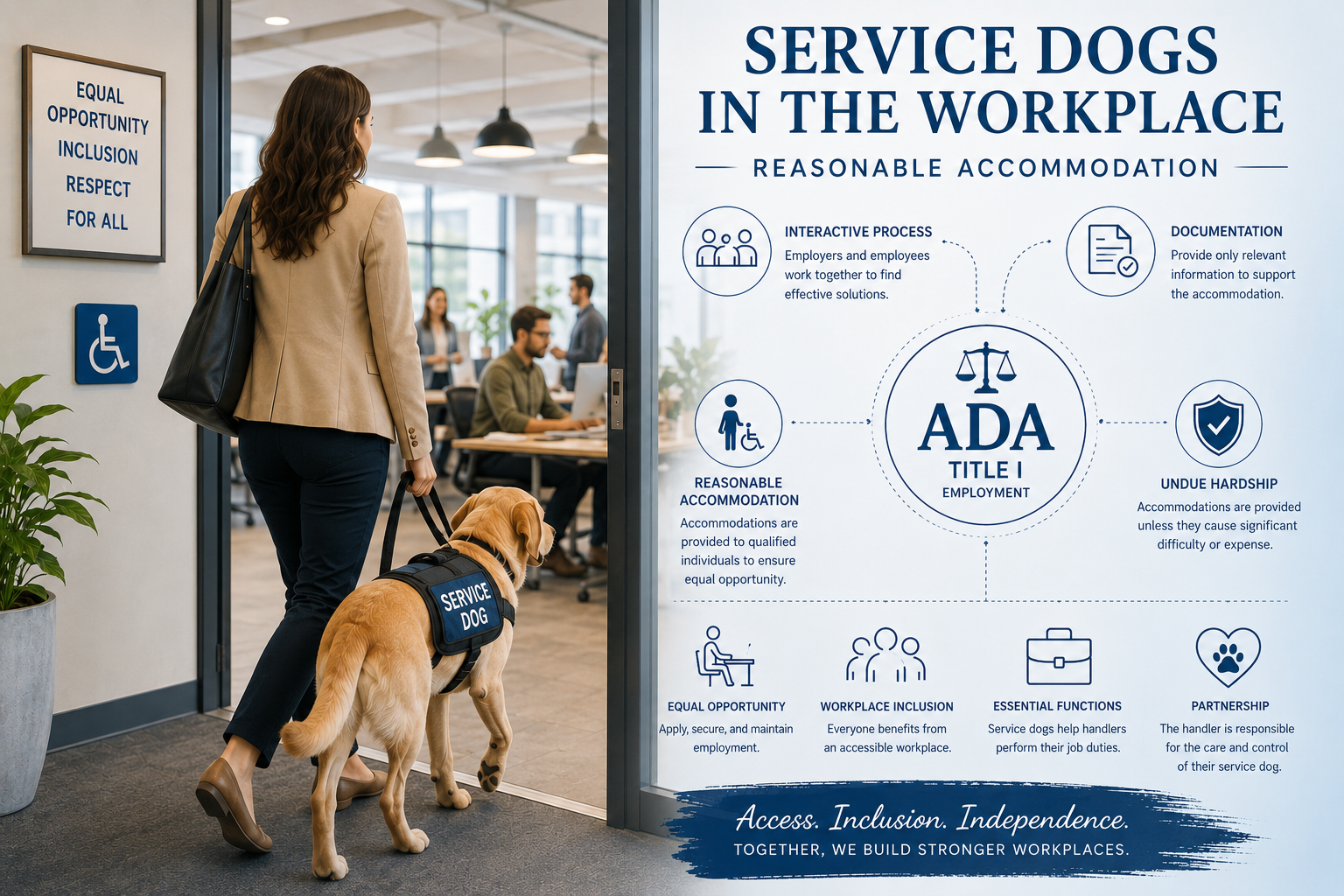
Service dog handlers often benefit from their animals in workplace environments. A service dog can enable persons with disabilities to access equal opportunity to apply, secure, and maintain employment, as well as its benefits and privileges. Employment is a powerful quality of life factor in the equality of life of any person, including persons with disabilities which are capable of working when provided with reasonable accommodations.
In the employment context (ADA Title I), the legal standard is reasonable accommodation and undue hardship, rather than the “fundamental alteration” language commonly seen in public access accommodations (ADA Titles II and III).
Title I requires an employer to provide reasonable accommodation to qualified individuals with disabilities who are employees or applicants for employment, unless to do so would cause undue hardship.
A service dog at work is generally treated as a request for reasonable accommodation. Employers must consider the request through an individualized, interactive process, but they do not automatically have to approve it.
This post reviews content from a couple of amazing resources that can help service dog handlers navigate employment-related concerns regarding having their service dog as a reasonable workplace accommodation.
The Service Dog Resource Page from the Job Accommodation Network (JAN)
This is excellent resource regarding service dogs in the workplace. While the information on this webpage is not from a governmental source and not legally binding, it generally reflects the interpretations provided in government resources such as the EEOC page mentioned. The general theme of the page is that requests to use a service animal at work should be handled through the ADA’s individualized reasonable-accommodation process, with employers and employees working collaboratively to find solutions rather than relying on blanket approvals or blanket denials.
Some of the key points addressed in the JAN page include:
- Unlike public accommodations under ADA Title II and III, ADA Title I (employment) does not contain a specific definition of “service animal” or detailed rules governing service animals in the workplace. As a result, requests to bring a service animal to work are analyzed as requests for reasonable accommodation.
- Employers must consider the request on a case-by-base basis, but need not automatically approve it and may deny it if allowing the animal would create an undue hardship
- The request for accommodations should be processed in a manner similar to how the employer would provide other accommodations for people with disabilities
- An employer can propose another effective accommodation instead of allowing a service animal, but should generally give significant weight to the employee’s preference for using a service animal, especially since they offer multiple benefits such as security, independence, confidence, or medical assistance that are often not as easily or adequately achieved with alternative accommodation.
- When the need for the service animal is not obvious, employers may request documentation showing that the employee has a disability, that the animal is needed because of that disability, and that the animal is appropriately trained and capable of functioning safely in the workplace.
- Documentation may come from sources other than a healthcare provider, such as a trainer, and employers may consider a trial period to evaluate whether the accommodation is effective.
- Since service dogs need not be certified per ADA law, employers should focus on whether the animal is trained, behaves appropriately, and can function safely in the workplace.
- If there are portions of a workplace where a service animal cannot safely enter, the employer should explore alternatives such as temporary separation or modification in work duties before denying the accommodation
- Employers generally should not simply exclude the service dog because another employee has allergies or a fear of dogs. Instead, employers should attempt to accommodate both employees.
- Unless otherwise allowed or requested by the employee, employers generally should not disclose that an employee has a disability or explain the details of the accommodation to coworkers. If coworkers need information, employers can simply explain that a dog will be present and provide guidance about interacting with it.
- The handler, not the employer, is responsible for caring for the animal, maintaining control, grooming and cleanliness, toilet breaks, and ensuring the animal is not disruptive. However, employers may need to provide accommodations that allow the employee to care for the dog, such as modified break schedules.
- While employees may choose to secure insurance to protect themselves from liability associated with handling a service dog in the workplace, employers should not make that a requirement for access.
- Employers and employees can work together to find practical solutions, but there is no clear federal requirement to construct or designate a specific relief area.
- Employees without disabilities who are training a service animal for someone else generally have no ADA accommodation rights. For employees with disabilities, employers may consider allowing a service animal in training, but concerns about disruption and workplace safety are legitimate factors. State laws may provide additional protections.
- Employers generally should not simply exclude the service dog because another employee has allergies or a fear of dogs. Reflecting a principle that allergies and service-dog use are competing accommodation needs, not an automatic reason to deny the service dog, employers should attempt to accommodate both employees. Possible solutions include separate work areas, different travel routes, air filtration systems, schedule changes, remote work arrangements, private offices, alternative communication methods.

We strongly recommend visiting the JAN page for a an excellent breakdown that includes for each topic included, an explanation of what it means for both employers and employees
The summary of the JAN page above and the information within that page itself may be sufficient for most handlers and other persons seeking work-place related information. Nevertheless, the resource below may provide additional guidance that many would benefit from. At the end of this page, there is also a series of links to further resources that readers may find useful on this topic.
The United States Equal Employment Opportunity Commission (EEOC) – Enforcement Guidance on Reasonable Accommodation and Undue Hardship under the ADA
This page that provides detailed explanations on how ADA Title I should be applied and interpreted in the context of the workplace. The page includes throughout it, legal citations to both statutes and case law. The page addresses several key topics that are related to service dogs in the workplace.
The following summarizes the information in this guidance. Most of the descriptions included, highlight general workplace accommodation information which is further detailed in the webpage linked above with accompanying examples. Nevertheless, after each section a summary of how that applies to service dogs has been added.
Reasonable Accommodations
- A reasonable accommodation or modification is one that appears practical, feasible, and workable under normal circumstances. It must also effectively address the individual’s needs and enable the person with a disability to perform the essential functions of their job and enjoy the same benefits and privileges of employment that employees without disabilities enjoy.
- Three categories of accommodations include: (i) changes to the hiring or application process that allow a qualified person with a disability to compete fairly for a job; (ii) changes to the work environment or how a job is performed that enable a qualified employee with a disability to carry out the essential functions of the position; and (iii) changes that allow an employee with a disability to enjoy the same workplace benefits, privileges, and opportunities as other employees.
- Providing reasonable accommodations is a core legal requirement because workplace barriers can prevent qualified individuals with disabilities from accessing or performing jobs.
- Employers have a duty to provide reasonable accommodations to qualified applicants and employees with disabilities regardless of whether they are applying for or already working in part-time, full-time, probationary, temporary, seasonal, or contract employment.
- Reasonable accommodation does not require an employer to remove essential job functions or lower performance and productivity standards that apply equally to all employees. An employee must still be able to perform the essential duties of the job, with or without accommodation, to be considered qualified under the ADA. However, employers may need to provide accommodations that help an employee meet those standards, and they are free to voluntarily waive requirements if they choose.
- Employers must ensure that employees with disabilities have equal access to workplace communications, information systems, announcements, and other employment-related information provided to other employees, unless doing so would cause undue hardship.
- Employers must provide accommodations necessary for employees with disabilities to participate equally in employer-sponsored training programs, whether the training is optional, mandatory, on-site, or provided by a third party, absent undue hardship.
- The fact that an employee with a disability does not need reasonable accommodation all the time does not relieve the employer from providing an accommodation for the period when he does need one.
Generally speaking, service dogs are considered reasonable accommodations. They allow equal opportunity for handlers to perform job functions, as well as maintain benefits and privileges of employment. They also do so in ways that often minimize the total number and complexity of accommodations needed.
Asking for an Accomodation
- To request an accommodation, an employee only needs to inform the employer that they need a workplace adjustment or change due to a medical condition. The request does not need to be formal, mention the ADA, or use the term “reasonable accommodation” as long as it communicates the need for assistance related to a disability. The request also does not need to be in writing.
- A family member, friend, health professional, or other representative may request a reasonable accommodation on behalf of an individual with a disability, but the individual with a disability may refuse to accept an accommodation that is not needed.
- An individual with a disability may request reasonable accommodation at any point during the hiring process or employment. They do not lose the right to request an accommodation simply because they did not ask for one earlier. An accommodation should be requested when the individual becomes aware that a disability-related workplace barrier is affecting their ability to apply for a job, perform their duties, or access employment benefits. Practically speaking, it is often best to request an accommodation before job performance or workplace conduct is negatively affected.
- The employer and employee should engage in an interactive process to identify the employee’s limitations, discuss possible accommodations, and determine an effective solution. The employer may ask relevant questions but must work in good faith to find an appropriate accommodation.
- If the disability or need for accommodation is not obvious, the employer may request reasonable documentation showing that the employee has a disability and needs the accommodation. The employer may only request information relevant to that determination, not complete medical records. If the employee’s documentation is insufficient. The employer must first explain what information is missing and give the employee an opportunity to provide it. Any employer-required examination must be job-related, limited in scope, and paid for by the employer.
- An employer cannot request additional documentation if the disability and need for accommodation are obvious or if the employee has already provided sufficient information establishing both the disability and the need for accommodation .If an individual provides sufficient documentation to show the existence of an ADA disability and the need for reasonable accommodation, continued efforts by the employer to require that the individual see the employer’s health professional could be considered retaliation.
- The employer may choose among effective accommodations and is not required to provide the employee’s preferred option. However, the chosen accommodation must effectively remove the workplace barrier and provide an equal employment opportunity.
- An employer must respond and engage in the accommodation process promptly. Unnecessary delays can violate the ADA, although reasonable delays caused by circumstances outside the employer’s control may be acceptable if the employer acts diligently. In determining whether there has been an unnecessary delay in responding to a request for reasonable accommodation, relevant factors would include: (1) the reason(s) for the delay, (2) the length of the delay, (3) how much the individual with a disability and the employer each contributed to the delay, (4) what the employer was doing during the delay, and (5) whether the required accommodation was simple or complex to provide.
- An employee cannot be forced to accept an accommodation. However, if the employee rejects an effective accommodation that is necessary to perform essential job functions or eliminate a direct threat, they may no longer be qualified for the position.
- Although individuals with disabilities are not required to keep records, they may find it useful to document requests for reasonable accommodation in the event there is a dispute about whether or when they requested accommodation. Employers, however, must keep all employment records, including records of requests for reasonable accommodation, for one year from the making of the record or the personnel action involved, whichever occurs later. If a charge is filed, records must be preserved until the charge is resolved.
- Since a doctor cannot disclose information about a patient without his/her permission, in the case that an employee chooses to provide information through a doctor, an employer must obtain a release from the individual that will permit his/her doctor to answer questions. The release should be clear as to what information will be requested. Employers must maintain the confidentiality of all medical information collected during this process, regardless of where the information comes from. Employers also may consider alternatives like having their health professional consult with the individual’s health professional, with the employee’s consent.
The process of requesting a service dog accommodation also follows all of these guidelines, but additional information may be needed by the employer as to how the service animal will facilitate the job functions performed by the handler. Employers are allowed to deny a service dog as an accommodation if they can provide alternative accommodations; however, alternatives should provide equal opportunities. Service dogs often reduce the total number of accommodations needed because they can assist in more than one way. While it is not necessary to make requests in writing, it is wise to do so for documentation purposes in case there is a dispute. Likewise, it is wise to ask for all responses to be documented in writing.

Accommodations & Job Applications
- Before a job offer, employers may only ask about accommodations for the application process, or about job accommodations when they know the applicant has a disability and reasonably believe accommodation will be needed. After a conditional job offer, employers may ask all applicants in the same job category about accommodation needs.
- Employers must provide reasonable accommodations needed for the application process unless doing so would cause undue hardship. They cannot deny an applicant access to the hiring process based on speculation that future workplace accommodations may not be feasible.
- An employer may not ask disability-related questions and may not conduct medical examinations until after it makes a conditional job offer to the applicant
It is not necessary and perhaps not advisable to divulge the desire for a service dog accommodation until after a job offer is made. Employers should really not even ask disability-related questions before a job offer is made.
Additional Reasonable Accommodation Issues
- The duty to accommodate is ongoing. Employers must evaluate each new accommodation request individually and provide additional accommodations when needed, effective, and not an undue hardship.
- Some courts have said that in determining whether an accommodation is “reasonable,” one must look at the costs of the accommodation in relation to its benefits. However, the benefits consideration should include the benefit to the employee and not only how the employee benefits the business. Cost considerations should also include analysis of how such costs can be mitigated.
- If an accommodation proves ineffective, the employer must consider alternative accommodations. If no effective accommodation exists, the employer must consider reassignment to a vacant position unless reassignment would create an undue hardship.
- The ADA does not require changing supervisors. However, employers may need to modify supervisory practices or communication methods to accommodate an employee’s disability.
- Employers must consider telework when it would enable the employee to perform the essential functions of the job and would not cause undue hardship. If the essential duties require on-site presence, working from home is generally not required.
- Employers may enforce conduct rules that are job-related and consistent with business necessity, even when the misconduct is related to a disability.
- While employers do not have to excuse past misconduct, they may need to provide a reasonable accommodation to help the employee meet conduct standards in the future, unless the appropriate discipline is termination.
- Employers are not required to monitor medication use or medical treatment because doing so does not remove a workplace barrier. However, accommodations such as breaks to take medication or leave for treatment may be required.
- If an employee fails to take medication, obtain treatment, or use an assistive device, employers must still provide reasonable accommodations. However, if the employee cannot perform the essential functions of the job or poses a direct threat without medication, treatment, or an assistive device, the employee may not be qualified for the position.
- Reasonable accommodation covers limitations caused by a disability, including side effects of treatment and secondary conditions resulting from the disability.
- The employee is usually responsible for requesting accommodation. An employer may ask when it reasonably believes a known disability may require accommodation, such as when performance issues arise or when workplace circumstances suggest accommodation may be needed. An employer should initiate the interactive process when it knows the employee has a disability, knows the disability is causing workplace problems, and has reason to believe the employee cannot request an accommodation on their own. However, employers shall not require a medical examination and shall not make inquiries of an employee as to whether such employee is an individual with a disability or as to the nature and severity of the disability, unless such examination or inquiry is shown to be job-related and consistent with business necessity.
- Employers generally cannot disclose that an employee is receiving a reasonable accommodation because doing so may reveal confidential medical information.
- The employer should protect the employee’s privacy and explain that it assists employees with workplace needs while respecting confidentiality. Employers may also educate employees generally about accommodation laws and privacy requirements without discussing any specific employee.
- Employees may choose to disclose their disability or accommodation to coworkers, provided the disclosure is voluntary and not pressured by the employer.
- Failure to transfer marginal functions because of its negative impact on the morale of other employees also could constitute disparate treatment when similar morale problems do not stop an employer from reassigning tasks in other situations.
Even if an employee already has other accommodations, they can request a service dog as a replacement, additional, or supplemental accommodation. Service dogs may only be considered a reasonable accommodation when they do not add costs to the business that cannot be mitigated and significantly exceed the benefits to the business and employee gained by the accommodation being provided. Nevertheless, in most cases, service dogs do not significantly affect the costs of a business while drastically benefiting the employee. Service dogs must be an effective accommodation in order for their continued use to be justified. Any job-related misconduct associated with service dog presence would still be enforced per conduct rules of the business. Unless they opt to, employers are not responsible for providing a service dog, handling the service dog, or caring for the service dog’s needs. A service dog is often a workplace accommodation that cannot reasonably be kept confidential. Nevertheless, employers generally cannot disclose why the accommodation is needed. They may need to educate other employees or customers about expectations of conduct related to an employee’s service dog. It is up to an employee how much they wish to share about their needs with others.

Undue Hardship
- This means significant difficulty or expense based on the employer’s specific resources and circumstances.
- It can include accommodations that are excessively costly, substantially disruptive, overly burdensome, or that fundamentally change the nature of the business.
- Whether an accommodation creates an undue hardship must be evaluated on a case-by-case basis.
Generally speaking, situations where service dogs would only be considered to cause undue hardship are rare. Their inclusion does not typically cause excessive costs, substantial disruption, over burden, or fundamental change to the nature of the business. Even if some changes are needed, so long as the business can still be conducted without adding a high cost to the business, service dogs should not be considered undue hardship.
Undue Hardship Issues
- An employer is not required to provide an accommodation that would create an undue hardship, but it must prove this through a case-specific analysis. Factors include the accommodation’s cost, the employer’s financial resources, size, operations, workforce structure, and the accommodation’s impact on the business.
- When evaluating cost-based undue hardship, employers must consider outside funding sources, grants, rehabilitation programs, and available tax credits or deductions. Undue hardship is based on the employer’s actual net cost after these resources are considered, and employers may also ask whether the employee is willing to cover any remaining excess cost.
- If one accommodation would cause undue hardship but another effective accommodation would not, the employer must provide the alternative accommodation.
- An employer cannot claim undue hardship based on fears, stereotypes, prejudice, customer preferences, or coworker resentment regarding a disability. However, undue hardship may exist if the accommodation would genuinely and significantly disrupt other employees’ ability to perform their work.
- If a lease requires landlord approval and the landlord refuses to permit disability-related modifications, the employer may be able to claim undue hardship regarding those specific changes. However, the employer must still provide another effective accommodation if one is available and does not create an undue hardship. Employers should consider their accommodation obligations when negotiating leases and property agreements. Property owners should carefully evaluate requests for disability-related modifications because refusing them may interfere with an employee’s ADA rights and may independently violate other ADA requirements.
- An employer is not required to modify work hours or grant leave if doing so would significantly disrupt operations by preventing other employees from performing their own jobs, as this may constitute an undue hardship.Leave without a fixed return date can be a reasonable accommodation, but an employer may deny it if the uncertainty creates an undue hardship, such as making it impossible to plan operations or fill the position effectively. Employers may require periodic updates and may reassess whether continued leave remains reasonable. Employers cannot automatically deny leave just because an employee can provide only an estimated return date. Employees should keep employers informed about their condition and expected return, and leave requests should be evaluated based on the actual circumstances rather than the lack of a precise date.
- Undue hardship is not determined by weighing the accommodation’s cost against its perceived value. Instead, the analysis focuses on the employer’s financial resources and operational circumstances, regardless of the employee’s position, salary, or status.
- The fact that an accommodation is used by only one employee should not be used as a negative factor counting in favor of a finding of undue hardship
As with any other accommodation business must consider the request for a service dog accommodation without simply doing a cost vs perceived benefit analysis. Generally speaking, service dogs do not cause undue hardship to businesses unless their presence very significantly impacts the business’s purpose or increases costs beyond what is feasible to the business due to added measures necessary to maintain safety or accommodate the needs of employees or customers. For example, service dogs would be a health and safety hazard in certain hospital settings. Exceptions will sometimes mirror the types of business where accommodating the service dog needs of customers may not be possible due to fundamental alteration to the business. For example, a business that provides services specifically for people with allergies may not be able to allow a service dog for one of its employees. Due to separate legislation, property owners generally should not be able to deny access of a service dog to the property such that a lessee may have a reason to claim inability to accommodate a service-dog because of undue hardship.
Burden of Proof
- In an ADA failure-to-accommodate lawsuit, the employee initially only needs to show that the requested accommodation appears reasonable on its face. Once that is shown, the burden shifts to the employer to prove, with specific evidence, that providing the accommodation would cause an undue hardship under the particular circumstances.
- This legal burden-shifting framework applies in court but does not change the employer’s obligation to engage in the interactive process. Employers must still communicate with the employee, gather relevant information, and work collaboratively to evaluate accommodation requests.
Since service dogs are generally reasonable accommodations provided that the task they perform facilitates the person with disability to perform their job duties, have equal work opportunity, and receive benefits and privileges associated with employment. Therefore, the burden of proof would be on an employer to demonstrate how accommodating a service dog would cause undue hardship. However, employers are allowed to provide alternative accommodation. Employers must in either case engage in an interactive process designed to best serve the needs of the employee that is a person with a disability. \

The following two sections are included for general informational purposes only.
Types of Reasonable Accommodations
- Job Restructuring: An employer may reassign or exchange marginal job duties among employees as part of a reasonable accommodation, provided it does not require the employee to perform functions they cannot do because of their disability.
- Leave: Employers may need to modify leave policies and provide additional leave as a reasonable accommodation unless another effective accommodation exists or the extra leave would create an undue hardship. Generally, an employer must hold the employee’s position open during approved disability-related leave unless doing so would cause undue hardship. If holding the position open is not possible, the employer must consider reassignment to a vacant equivalent position. An employer cannot punish, discipline, or disadvantage an employee for taking disability-related leave that qualifies as a reasonable accommodation. Doing so may constitute retaliation and a failure to accommodate.An employer may choose an effective alternative accommodation instead of leave if it adequately addresses the employee’s needs and does not interfere with necessary medical treatment. The employer must evaluate the employee’s rights under both FMLA and ADA laws separately and provide whichever protections are greater. ADA leave rights may extend beyond the leave available under the FMLA if additional leave is a reasonable accommodation and does not create undue hardship.
- Modified or Part-Time Schedule: Employers must provide modified or part-time schedules when necessary because of a disability, unless doing so would create an undue hardship. The employer must consider the employee’s rights under both ADA and FMLA laws. If either law requires the modified schedule, the employer must comply with that requirement, even if the accommodation would not otherwise be required under the other law.
- Modified Workspace: Employers may be required to modify workplace policies, including attendance, leave, food, drink, or scheduling policies, when necessary to accommodate a disability, unless doing so would create an undue hardship. The modification only needs to apply to the employee who requires the accommodation.
- Reassignment: See more on this below
Reassignment as a Reasonable Accommodation
- Reassignment to a vacant position may be required when an employee can no longer perform the essential functions of their current job because of a disability, even with reasonable accommodation, unless the reassignment would create an undue hardship. The employee must be qualified for the vacant position by meeting its required skills, experience, education, and other job-related requirements, and must be able to perform the essential functions of the new position, with or without reasonable accommodation. The employee does not have to be the most qualified applicant.
- An employer is not required to provide special training to help an employee become qualified for a new position. However, the employer must provide the same training that is normally given to any employee who is hired into or transferred to that position.
- Reassignment is considered a last-resort accommodation. Employers must first explore accommodations that would allow the employee to remain in their current position. Reassignment is only required if no effective accommodation exists or if all other accommodations would create an undue hardship. However, reassignment may occur sooner if both parties agree it is the preferred solution.
- A position is considered “vacant” if it is currently open or is expected to become available within a reasonable period of time. Employers are not required to create a new position or remove another employee from a position to create a vacancy.
- An employer must first place the employee into a qualified vacant position that is equivalent in pay, status, benefits, and other relevant factors. If no equivalent position is available, the employer must consider lower-level positions. If multiple suitable vacancies exist, the employee should be placed in the one most comparable to their current position. Reassignment does not require a promotion.
- Employees cannot be denied reassignment solely because they are classified as probationary. If they were able to perform their job’s essential functions before the disability-related need for reassignment arose, they remain eligible for
- The stronger the employee’s history of successfully performing the job, the more appropriate reassignment becomes if a disability later prevents continued performance. However, an employee who was never qualified to perform the essential functions of the original position is not entitled to reassignment because they were never a qualified employee under the ADA.
- Employers must provide reassignment as a reasonable accommodation even if they do not normally transfer employees. Existing no-transfer policies may need to be modified to accommodate a qualified employee with a disability unless doing so would create an undue hardship.
- Because the employer is in the best position to know what jobs are available, it must help identify and inform the employee about vacant positions for which the employee may qualify. The employee should also assist by providing information about their qualifications, interests, and any vacancies they know about.
- The employer must act as quickly as reasonably possible. The time required depends on the size and complexity of the organization, but the employer fulfills its duty once it has searched for vacancies, informed the employee of the results, and either offered an appropriate position or explained that none are available.
- Reassignment means the employee is placed into the vacant position if they are qualified for it. The employee does not have to compete against other applicants for the position.
- An employer generally may reduce the employee’s pay to match the lower-level position, unless it has a policy of maintaining the salaries of other employees who are transferred to lower-level jobs.
- Reassignment is usually not required if it would conflict with a legitimate seniority system because doing so would undermine employees’ expectations of consistent treatment.
- Reassignment may still be reasonable if special circumstances show that employees could not reasonably rely on the seniority system, such as when the employer frequently makes exceptions, retains broad authority to change the system, or the system already contains procedures allowing exceptions.
The EEOC website has many additional resource pages. Please see the link list below for more!\

Additional Links to Resources on Service Dogs in the Workplace
- ADA National Network
- Service Animals, Small Business, and Other
- Taking a Service Dog to Work
- Employees’ Practical Guide to Requesting and Negotiating Reasonable Accommodation Under the Americans with Disabilities Act
- Differences between a “reasonable accommodation” and a “reasonable modification of policies, practices, or procedures”
- Equal Employment Opportunity Commission
- How to File a Charge of Employment Discrimination
- Mediation
- Facts About the Americans with Disabilities Act
- Definition of Disability under ADA Amendment Act of 2008
- Fact Sheet: Disability Discrimination
- Disability Discrimination and Employment Decisions
- Your Employment Rights as an Individual with a Disability
- Job Applicants and the ADA
- Guides for Persons with Specific Disabilities
- Understanding Your Employment Rights Under the Americans with Disabilities Act: A Guide for Veterans
- Enforcement Guidance
- Reasonable Accommodation and Undue Hardship under the ADA
- Preemployment Disability-Related Questions and Medical Examinations
- Disability-Related Inquiries and Medical Examinations of Employees under the ADA (Guidance / FAQ)
- Retaliation and Related Issues (Guidance / FAQ)
- Obtaining and Using Employee Medical Information as Part of Emergency Evacuation Procedures
- The Mental Health Provider’s Role in a Client’s Request for a Reasonable Accommodation at Work
- Applying Performance and Conduct Standards to Employees with Disabilities
Application of the ADA to Contingent Workers (Guidance / FAQ) - The Application of Title VII and the ADA to Applicants or Employees Who Experience Domestic or Dating Violence, Sexual Assault, or Stalking
- ADA & Psychiatric Disabilities
- Workers’ Compensation and the ADA
- Employer-Provided Leave and the Americans with Disabilities Act
- Application of the ADA to disability-based distinctions in employer-provided health insurance
- Work at Home/Telework as a Reasonable Accommodation
- AI & Discrimination
- Small Employers and Reasonable Accommodation
- Association Provision (protections for work-related discrimination for those associated or in a relationship with a disabled person)
- Practical Guidance for Employers (also see enforcement guidance above)
- Recruiting, Hiring, Retaining, and Promoting People with Disabilities
- The ADA: A Primer for Small Business
- The Final Rule Implementing the ADA Amendments Act of 2008
- Disability Discrimination Resources for Employers
- Small Business Fact Sheet: Retaliation and Related Issues
- Veterans and the Americans with Disabilities Act: A Guide for Employers
- Practical Advice for Drafting Implementing Reasonable Accommodation Procedures
- Establishing Procedures to Facilitate the Provision of Reasonable Accommodation (Guidance / FAQ)
- Disability-Related Tax Provisions
- Laws & Regulations
- ADA Title I & V
- ADA Amendment Act of 2008
- 29 C.F.R. Part 1602: Recordkeeping and reporting requirements under title VII, the ADA, and GINA.
- 29 C.F.R. Part 1614: Federal sector equal opportunity regulation, which implements section 501 of the Rehabilitation Act, among other EEO laws.
- 29 C.F.R Part 1630: Regulations to implement the equal employment provisions of the Americans with Disabilities Act
- 29 C.F.R Part 1640: Procedures for coordinating the investigations of complaints or charges of employment discrimination based on disability subject to the Americans with Disabilities Act and section 504 of the Rehabilitation Act of 1973
- 29 C.F.R Part 1641: Procedures for complaints/charges of employment discrimination based on disability filed against employers holding government contracts or subcontracts.
- Final rule to amend the regulations and interpretive guidance implementing Title I of the Americans with Disabilities
- United States Department of Labor
- Additional Government Agency Websites
- Additional Disability Support Websites
- Resources for Business Owned by Persons with Disabilities
Disclaimer: The information provided in this article is for general educational and informational purposes only and is not intended as legal advice. Laws, regulations, and their application may vary depending on the specific facts and circumstances of each situation. Reading this material does not create an attorney-client relationship, nor should it be relied upon as a substitute for professional legal counsel. Individuals and organizations facing specific legal questions or disputes should consult a qualified attorney or other appropriate professional regarding their particular circumstances.