




Service Dog Rights: Allergies & Access
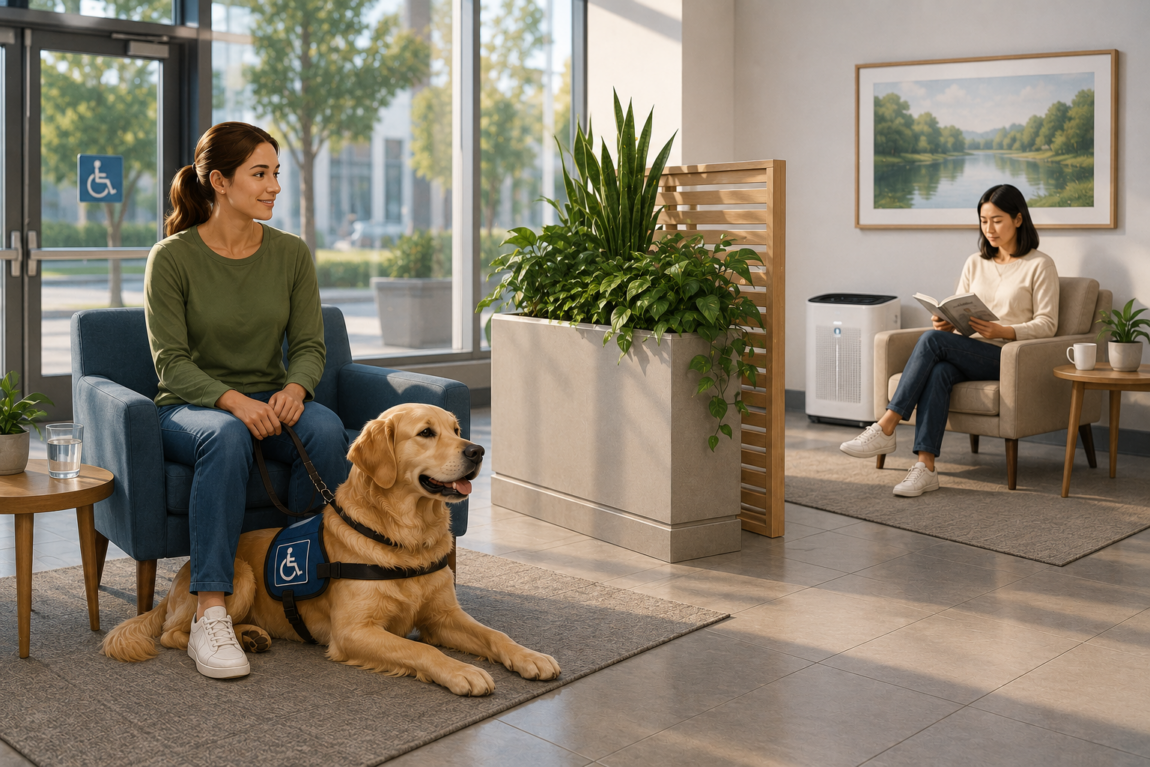
Accommodating Needs of Persons with Disabilities with Consideration of Allergies of Others
Service dog handlers frequently encounter barriers to access in public accommodations, workplaces, housing, and other settings. One common issue arises when a business, employer, or member of the public objects to the presence of a service dog based on concerns about allergies experienced by others. While allergies can present legitimate considerations that may require reasonable accommodations for all affected individuals, they generally do not justify automatically excluding a service dog or denying access to a person with a disability. Instead, federal disability laws and guidance typically require an individualized assessment and, where possible, accommodations that allow both the service dog handler and the person with allergies to access services, programs, employment, or facilities. Understanding how these situations are addressed under the law can help service dog handlers, employers, businesses, and the public navigate competing needs while maintaining compliance with disability rights protections.
Public Access Considerations
Service dog handlers routinely access public spaces, government facilities, businesses, and places of public accommodation with the assistance of their service dogs. However, conflicts sometimes arise when another individual expresses concerns about allergies to dogs. These situations may occur in restaurants, stores, hotels, parks, medical offices, government buildings, transportation systems, and other public settings. Under Titles II and III of the ADA, covered entities generally may not exclude a service dog solely because another person has allergies. Instead, they are expected to consider reasonable measures that accommodate the needs of all individuals while preserving the service dog handler’s right to access programs, services, and facilities.
The following provides information and references for those seeking to learn more about service dog handler’s rights in this context.
Department of Justice Guidance
For handlers looking for the strongest authority in the United States, the best citation comes directly from the Americans with Disabilities Act (ADA) guidance pages maintained by the Civil Rights Division of the U.S. Department of Justice (DOJ).

Frist, the ADA 2010 Revised Requirements: The official ADA Service Animals Guidance page specifically notes that allergies and fear of animals are generally not valid reasons for denying access.
“Allergies and fear of dogs are not valid reasons for denying access or refusing service to people using service animals. When a person with a dog allergy and a person using a service animal must be in the same facility, both individuals should be accommodated, such as by placing them in different locations within the room or different rooms in the facility.”
The same page also states that the only valid reasons to ask a service animal to be removed is if:
- the animal is out of control AND the handler does not take effective action to control it;
- The dog is not housebroken;
Therefore, allergies are not listed as valid reasons for exclusion and specifically addressed as reasons why a service dog should not be excluded in the guidance provided.
The DOJ’s Service Dog Frequently Ask Questions (FAQ) page provides further support to this reasoning. It states that covered entities must make reasonable modifications to permit service animals and cannot exclude them based on stereotypes, assumptions, or the preferences of others.
The same page also addresses reasons why service animals may be excluded. These include the same reasons mentioned above. It further states: “The ADA does not require covered entities to modify policies, practices, or procedures if it would “fundamentally alter” the nature of the goods, services, programs, or activities provided to the public.”
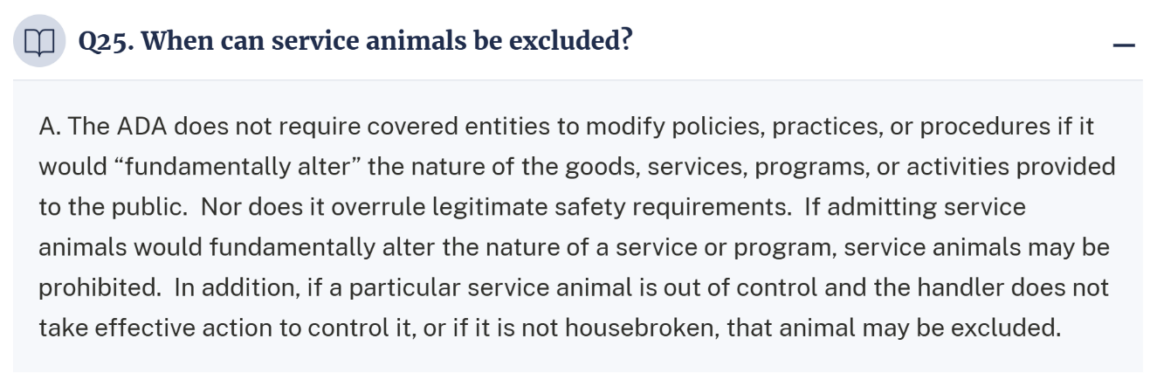
In other words the ADA does not require accommodations for service dogs where their presence would alter the core nature of the services or programs being provided. However, provided that the handler has a disability and a dog trained to perform a task to help mitigate that disability, the burden would be on the person or entity who denied access to demonstrate that the presence of the service dog would render the business or location unable to continue its purpose.
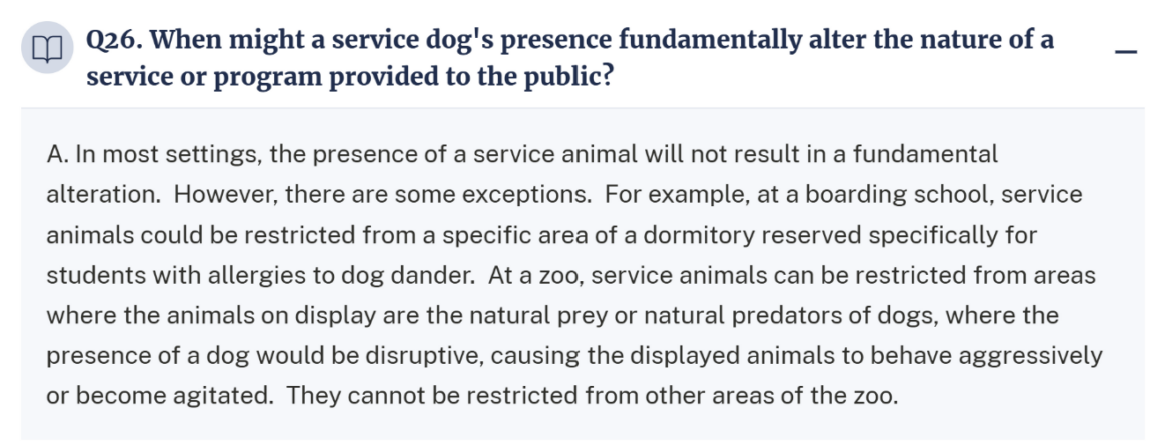
In the context of allergies, impacts on a person who is allergic in the presence of dogs does not mean that the general operations of a business or other public access location are no longer possible or are disrupted to the point that operations cannot continue, unless the purpose is providing services for people who are allergic. This is specifically addressed in the same FAQ page which also mentions that “in most settings, the presence of a service animal will not result in a fundamental alteration”.
Enforcement interpretation available at the DOJ’s website is helpful, but one may want to find specific references in the protective law. This will be discussed next.
Actual ADA Law & Associated Federal Regulations
While the exact “allergies are not a valid reason” language appears in DOJ guidance rather than the statute itself, the underlying legal authority is:
American with Disabilities Act: Title II & Title III
See also regulations: 28 C.F.R. § 35.136 (Title II) and 28 C.F.R. § 36.302(c) (Title III)
Under these regulations, a service animal may generally only be excluded when:
- The animal is out of control and the handler does not take effective action to control it;
- The animal is not housebroken.
And that service dog accommodations do not have to be provided when:
- The presence of a service animal would “fundamentally alter” the nature of the goods, services, programs, or activities provided to the public
The law states that service dog accommodations do not have to be provided or that service animals may only be excluded under specific circumstances. This is done intentionally. Rather than address every possible scenario of inclusion, the law outlines the ONLY possible scenarios where inclusion would not apply or where exclusion would apply. Thus, it is not necessary for the law to make specific mention of allergies in order for that circumstance to be examined under the law.
In addition to these regulations, decades of case law now include several court cases where decisions provide interpretations of the law, its application, and enforcement. Visit our Service Dog Federal Law Cases page for a full list of relevant cases organized by category and listed in reverse chronological order.
Workplace Accommodation Considerations
The workplace presents a different legal framework when service dogs are used as part of an employee’s disability-related accommodation. Employers may encounter situations where an employee who uses a service dog and another employee with allergies or sensitivities both require accommodation. Employers may also have concerns about the impact of a service dog in the operations of their business, including any persons served directly in their premises. In these circumstances, the ADA generally requires an individualized assessment and an interactive process to identify effective accommodations. Rather than automatically denying a service dog accommodation request, employers should evaluate the specific circumstances and explore solutions that address the needs of all affected employees while maintaining compliance with their obligations under the ADA.
In the employment context, the legal standard (ADA Title I and V) is reasonable accommodation and undue hardship, rather than the “fundamental alteration” language commonly seen in public accommodations (ADA Titles II and III).
Title I requires an employer to provide reasonable accommodation to qualified individuals with disabilities who are employees or applicants for employment, unless to do so would cause undue hardship.
Service dogs should generally be considered reasonable accommodations and employers must consider the request through an individualized, interactive process, but they do not automatically have to approve it.
The following provides information and references for those seeking to learn more about service dog handler’s rights in this context.
Equal Employment Opportunity Commission (EEOC)
In the United States,the EEOC is the government agency website that provides the clearest guidance on the rights of persons with disabilities in the workplace. The EEOC is the agency that enforces Title I of the ADA. In more than one page in the EEOC website, it is stated clearly that “Title I of the ADA requires an employer to provide reasonable accommodation to qualified individuals with disabilities … unless to do so would cause an undue hardship.” One such page is their excellent guidance page on Reasonable Accommodation and Undue Hardship under the ADA. Under Title I, service animals are considered a reasonable accommodation, and changes to a no-animals policy may be required when necessary to accommodate an employee with a disability.
Job Accommodation Network (JAN)
The Service Dog Resource Page from the Job Accommodation Network (JAN) is another excellent resource regarding service dogs in the workplace. According to JAN, a r request to bring a service animal to work can be processed like any other request for reasonable accommodation. Employers must consider the request, but do not have to automatically allow it if it would create an undue hardship or other legitimate workplace concern. The JAN website also has a specific page that addresses the issue of accommodation conflicts with other employees.cbgu
ADA National Network
A webpage in the ADA National Network site explains that under Title I, service animals are considered a reasonable accommodation, and changes to a no-animals policy may be required when necessary to accommodate an employee with
Northwest ADA Center
The Northwest ADA Center page for Service Dogs as an Employment Accommodation is another resource that also highlights key aspects of service dogs as reasonable accommodations in the workplace.
Specific guidance with regards to allergies is not explicit in governmental resources. Nevertheless, both disability-rights guidance and EEOC-related resources generally favor attempting to accommodate both individuals when the needs of a service dog handler and the needs of another employee or customer need consideration. That is, an employer may not deny the use of a service dog solely because another employee or a customer has allergies or discomfort around dogs. In a manner parallel to what was discussed in the public access session of this post, businesses should generally allow a service dog as a reasonable accommodation unless the nature of the business, business location, or location within the business has the purpose of providing services specifically for people with allergies. Instead of denying access, the employer should engage in the interactive process and attempt to reasonably accommodate both employees unless doing so would impose an undue hardship or create a direct threat. Rather than excluding the service dog outright, employers should use strategies such as separation of employees, different work areas, schedule adjustments, air filtration, or other measures are typically explored before denying the accommodation.
For more general information about navigating employment-related service dog access issues, see visit our Service Dog Rights: Workplace post.
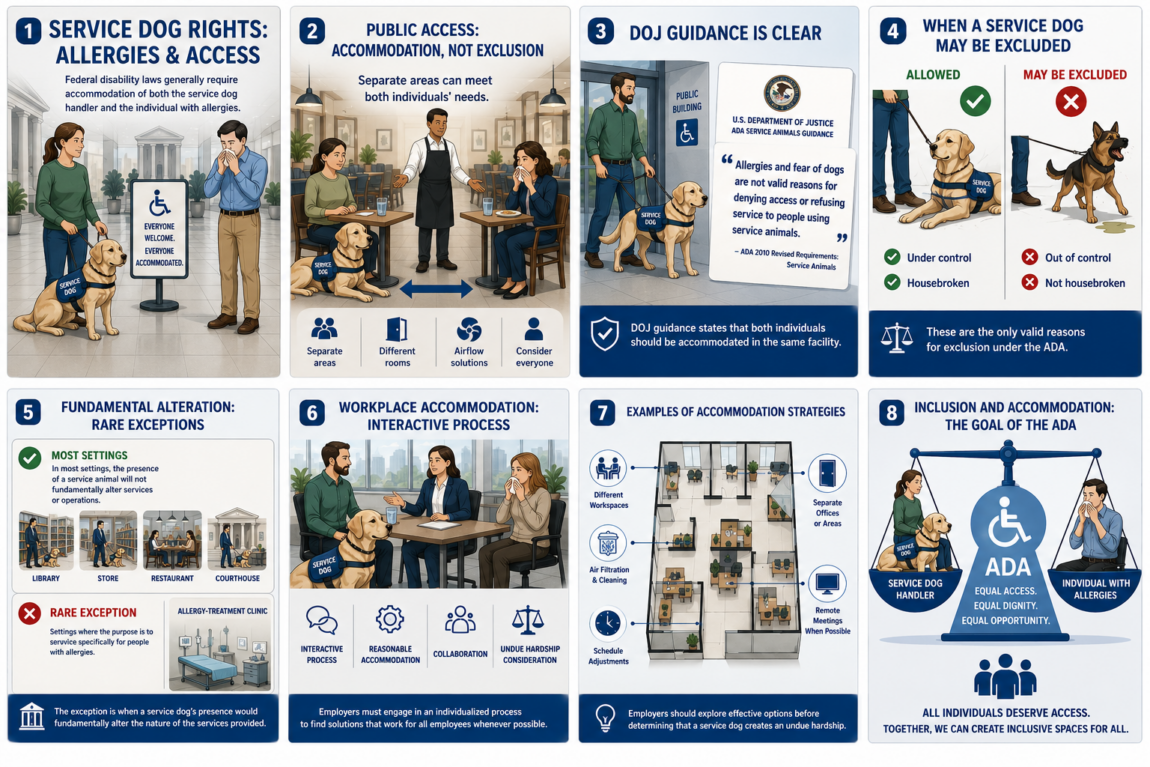
In both public access and workplace settings, allergies generally do not justify the automatic exclusion of a service dog. Instead, federal disability laws typically require an individualized assessment and consideration of accommodations that allow all affected individuals to participate, access services, or perform their jobs whenever reasonably possible.
Disclaimer: The information provided in this article is for general educational and informational purposes only and is not intended as legal advice. Laws, regulations, and their application may vary depending on the specific facts and circumstances of each situation. Reading this material does not create an attorney-client relationship, nor should it be relied upon as a substitute for professional legal counsel. Individuals and organizations facing specific legal questions or disputes should consult a qualified attorney or other appropriate professional regarding their particular circumstances.