





For many individuals with disabilities, a service dog can provide greater independence, safety, and quality of life. However, obtaining and training a service dog often requires a significant financial investment. Depending on the type of training, equipment, veterinary care, and support services involved, the costs can be substantial.
If you’re interested in learning more about the expenses associated with service dog training, be sure to read our companion article series, The Costs of Service Dog Training, which breaks down the various expenses that handlers may encounter throughout the process.
The good news is that many service dog handlers successfully obtain funding through a variety of sources. While there is rarely a single solution that works for everyone, combining multiple funding strategies can make service dog training far more accessible.
Many service dog handlers choose to fund all or part of their training through personal savings. While this option may not be feasible for everyone, creating a dedicated savings plan can help spread costs over time.
Some individuals begin setting aside funds months or even years before acquiring a service dog prospect. Others save while simultaneously researching programs, trainers, and equipment needs.
Handlers often had a previous service and start saving to train a new one when their previous dog approaches retirement. That is always a good idea, when possible.
Although saving takes time, it provides flexibility and allows handlers to make training decisions without relying on outside funding sources or restrictions.


Friends and family are often among the first people willing to help when someone is pursuing a service dog. Loved ones may contribute directly to training expenses, assist with equipment purchases, or provide support during fundraising efforts.
Many handlers find that family members are eager to contribute when they understand how a service dog can improve independence and daily functioning. Even small contributions can add up over time and help offset significant training costs.
Crowdfunding has become one of the most common ways people raise money for service dog training.
Platforms such as GoFundMe and similar fundraising websites allow individuals to share their stories and seek support from friends, family, and members of the public. Successful campaigns often explain:
- Why a service dog is needed
- How the dog will assist with disability-related tasks
- The expected costs involved
- The handler’s training goals
- Updates showing progress throughout the journey
Transparency is important. Donors are generally more likely to contribute when they understand exactly how funds will be used and can follow the handler’s progress over time.
Another important aspect is sharing it across social media platforms and having friends/family share as well.
While crowdfunding campaigns do not always reach their fundraising goals, they can be an effective way to raise a portion of the necessary funds.

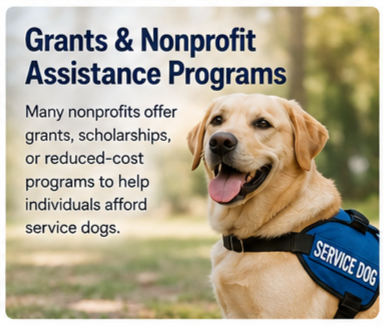
Various nonprofit organizations offer grants or financial assistance programs designed to help individuals obtain service dogs.
These programs vary significantly. Some provide direct funding for training expenses, while others offer scholarships, reimbursements, equipment assistance, or reduced-cost services.
Grant opportunities often have specific eligibility requirements, application deadlines, and documentation requirements. Applicants may be asked to provide medical documentation, proof of disability, training plans, financial information, or letters of recommendation.
Because grant funding can be competitive, it is often beneficial to apply to multiple programs rather than relying on a single source.
While several of the grant opportunities are for specific disabilities or age groups, it is possible to find resources online. Use google or AI to help you!
Many national, state, and local disability organizations offer assistance programs that may help cover some service dog-related expenses.
Depending on the organization and the individual’s circumstances, funding may be available through:
- Independent living programs
- Disability advocacy groups
- Community assistance organizations
- Disease-specific nonprofits
- Veterans’ organizations
Our Resources page has links to several such organizations. Contacting their representatives may help point you in the right direction for grants and programs.
These programs may not always advertise service dog funding directly, but they may offer grants or assistance for disability-related independence and mobility needs that can sometimes be applied toward service dog expenses.
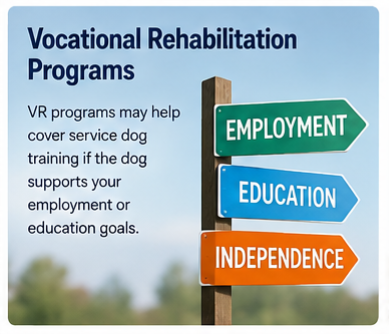
Individuals seeking a service dog to assist with employment, education, or career development may wish to explore vocational rehabilitation services.
Many states operate vocational rehabilitation programs that help individuals with disabilities obtain tools and resources necessary for employment. In some circumstances, a service dog may qualify as part of a broader employment accommodation or vocational support plan.
Eligibility requirements and available services vary by state, and approval is not guaranteed. However, vocational rehabilitation agencies can be a valuable resource for individuals whose service dog directly supports employment goals.
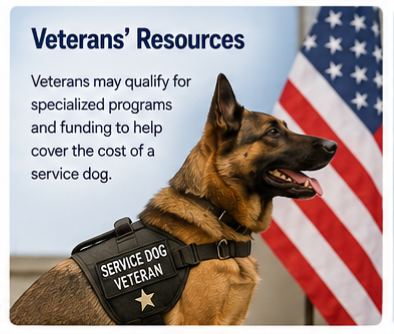
Veterans may have access to funding opportunities that are unavailable to the general public.
Depending on the individual’s circumstances and disability-related needs, veterans may qualify for assistance through veterans’ service organizations, nonprofit programs, or government-supported resources.
Because available benefits can vary widely, veterans should consult qualified professionals and relevant agencies to determine what programs may apply to their specific situation.

Traditional fundraising remains an effective way for many service dog handlers to raise money.
Community fundraising efforts may include:
- Benefit dinners
- Charity auctions
- Bake sales
- Raffles (where permitted by law)
- Car washes
- Online auctions
- Community sponsorship events
These events not only raise funds but also help educate the public about service dogs and disability access.
Many handlers find that local communities are willing to support their efforts when they understand the positive impact a service dog can have on daily life.
In some situations, employers, colleges, universities, or educational support programs may provide resources that help offset certain costs associated with disability accommodations.
While service dog funding is not commonly provided directly, individuals may be able to identify disability support resources, scholarships, grants, or accommodation-related programs that reduce other expenses and make service dog training more financially manageable.
Exploring every available resource can sometimes uncover opportunities that are not immediately obvious.


Some individuals may be able to use funds from a Health Savings Account (HSA) or Flexible Spending Account (FSA) to help cover certain service dog-related expenses. An HSA and an FSA are employer-sponsored or individually maintained accounts that allow individuals to set aside pre-tax money for qualified healthcare expenses. An HSA is typically available to individuals enrolled in a qualifying high-deductible health plan, and unused funds generally roll over from year to year. In contrast, an FSA is commonly offered through employers and may have annual contribution limits and rules regarding unused funds. Some FSA’s can also be secured directly by individuals.
Because contributions are made before taxes are applied, using HSA or FSA funds for eligible service dog-related expenses can effectively reduce the overall cost by allowing individuals to pay with pre-tax dollars rather than after-tax income. Total savings depend on the person’s tax bracket – that is in terms of what percentages are usually taken for tax purposes. That in turn depends on the person’s total income and tax credits / deductions. Contributing to a savings account may have a secondary benefit of reducing total income subject to taxes overall for the tax year, which in turn lowers the amount of taxes a person has to pay in general – potentially providing additional savings.
Anyone who has access to this as a benefit and plans to use their own funds to pay for some part of the cost of training a service dog should consider this option. Basically, rather than paying for it directly, one would choose to send to the savings plan pre-tax contributions equivalent to the amount to be paid towards eligible service dog related expenses and then pay the expenses using the savings account card.
Eligibility to use health saving account funds for service dog training depends on the specific expense and the requirements of the account administrator. In some cases, costs associated with obtaining, training, or maintaining a service dog may qualify as medical expenses when the dog is used to mitigate the effects of a disability. Documentation from a healthcare provider may be required.
Individuals should consult a qualified tax professional, account administrator, or financial advisor to determine which expenses may be eligible for reimbursement under their particular plan. While HSAs and FSAs may not cover every service dog-related expense, they can provide meaningful savings for many handlers who are funding training on their own.
Financing Through Credit Cards and Personal Loans
Some individuals choose to finance service dog training through credit cards, personal loans, or other financing options. While borrowing money is not ideal for everyone, it can make training accessible when the benefits of a service dog are needed sooner rather than later.
Personal loans often provide a fixed repayment schedule and predictable monthly payments, which can make budgeting easier. Credit cards may offer promotional financing periods or rewards programs that can help offset certain expenses. However, interest rates and fees can significantly increase the overall cost of training if balances are not paid off promptly.
Before pursuing financing, individuals should carefully evaluate their budget, compare interest rates, and consider the total cost of repayment. A service dog can provide life-changing assistance, but it is important to ensure that any financing arrangement remains affordable over the long term.
For some handlers, financing serves as a bridge while they continue to save money, apply for grants, or conduct fundraising efforts. When used responsibly, it can be one of several tools that helps make service dog training financially achievable.

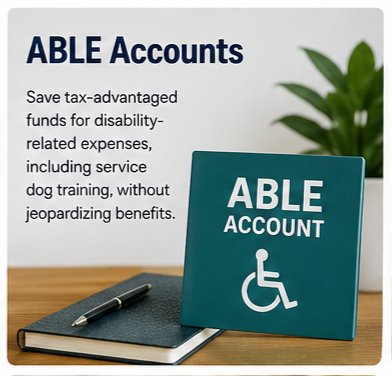
An ABLE (Achieving a Better Life Experience) account is a tax-advantaged savings account available to many individuals with disabilities. These accounts allow eligible individuals to save and spend money on qualified disability-related expenses without affecting eligibility for certain means-tested benefits, such as Supplemental Security Income (SSI) and Medicaid, subject to applicable program rules and limits.
Funds in an ABLE account can be used for a wide range of disability-related expenses, including education, housing, transportation, assistive technology, healthcare, and other expenses that help support the individual’s health, independence, and quality of life. Depending on a person’s circumstances, service dog-related expenses may qualify as disability-related expenses.
ABLE accounts can be particularly valuable for individuals who receive disability benefits because they provide a way to save money specifically for future disability-related needs without jeopardizing important benefits. Family members and friends may also contribute to an individual’s ABLE account, making it a useful tool for long-term planning and funding significant expenses such as service dog training.
For most service dog handlers, funding does not come from a single source. Instead, successful funding efforts often involve a combination of personal savings, fundraising, grants, family support, and community assistance.
For example, a handler might save a portion of the training costs, receive a small grant from a nonprofit organization, and raise additional funds through a crowdfunding campaign. By combining multiple funding methods, the overall financial burden becomes more manageable.

Final Thoughts
The cost of obtaining and training a service dog can feel overwhelming, particularly for individuals already managing disability-related expenses. However, many handlers successfully achieve their goals by exploring multiple funding options and developing a realistic financial plan.

While every situation is different, persistence and creativity often play a major role in securing the resources needed for a service dog. By researching available programs, reaching out to community resources, and leveraging fundraising opportunities, many individuals are able to overcome financial barriers and move forward with their service dog journey.
If you are reading this and searching for ways to fund your service dog journey, we sincerely hope you find the resources and support you need. Obtaining and training a service dog can be a significant investment, but there are often more options available than many people realize.
We hope this guide has provided ideas and inspiration as you explore funding opportunities. Our goal is to help individuals and families achieve success with their service dog journey and to support them in any way we can. Nothing is more rewarding to us than seeing satisfied customers, successful service dog teams, and the increased independence and confidence that a well-trained service dog can provide
If you’re still evaluating the financial commitment involved, we encourage you to read our Costs of Service Dog Training article series for a detailed breakdown of the expenses commonly associated with obtaining, training, and maintaining a service dog.
In addition, see our post about organizations that can potentially help you find funding or free or low cost service dog training.